
 SeekaHost.com Client Area
  SeekaHost.app
  SeekaHost.co.uk
  SeekaHost.in
How to Install Free SSL in cPanel?

Before getting into the topic “How to Install AutoSSL in cPanel?” we should be clear about why we need to install SSL for the websites?
One of the most important backbones of online business is just creating a secured and trusted environment.
So an SSL certificate creates a foundation of trust by providing a secure connection. It creates a secured connection between the client and a server. SSL encrypts the data/information sent across the internet.
This is because; the information that you sent on the internet will travel from one computer to another computer to reach its destination place.
Anyone in between you and the server can be able to access your data/information that passes through the internet if it’s not encrypted. If you installed an SSL certificate for your website, the information that you send through this site will become unreadable except the destination server.

Auto SSL
AutoSSL is one of the best features in cPanel & WHM. By using AutoSSL, it automatically installs and renews Let’s Encrypt SSL certificates for every domain. SSL Installation and Renewal is one of the complex tasks. So most of the web hosting providers comfort the clients with Auto SSL to do the tasks easily. Here, you don’t want to fill out any forms or install the certificates manually. Once you enabled AutoSSL, your websites will be automatically secured free, domain validated SSL certificate. AutoSSL will not force the site to load in https, it needs to be changed manually.
Here, I have explained you how to enable AutoSSL in cPanel.
How to Install Auto SSL in cPanel?
- Login to the cPanel Account.
- Under Security section, click SSL/TLS Certificates option.

- Click “Wizard” tab.

- Select the checkbox for the main domain to include all subdomains if pointed already. Click the Continue button.

- Now click Let’s Encrypt Certificate button.

- Now in the popup window, click checkbox to accept the terms of Let’s Encrypt. Click Continue button.

- Now the SSL certificate will be installed in the cPanel for the website.

- SSL for the subdomain will be automatically covered once the server cron runs, as long as the main domain has SSL installed.

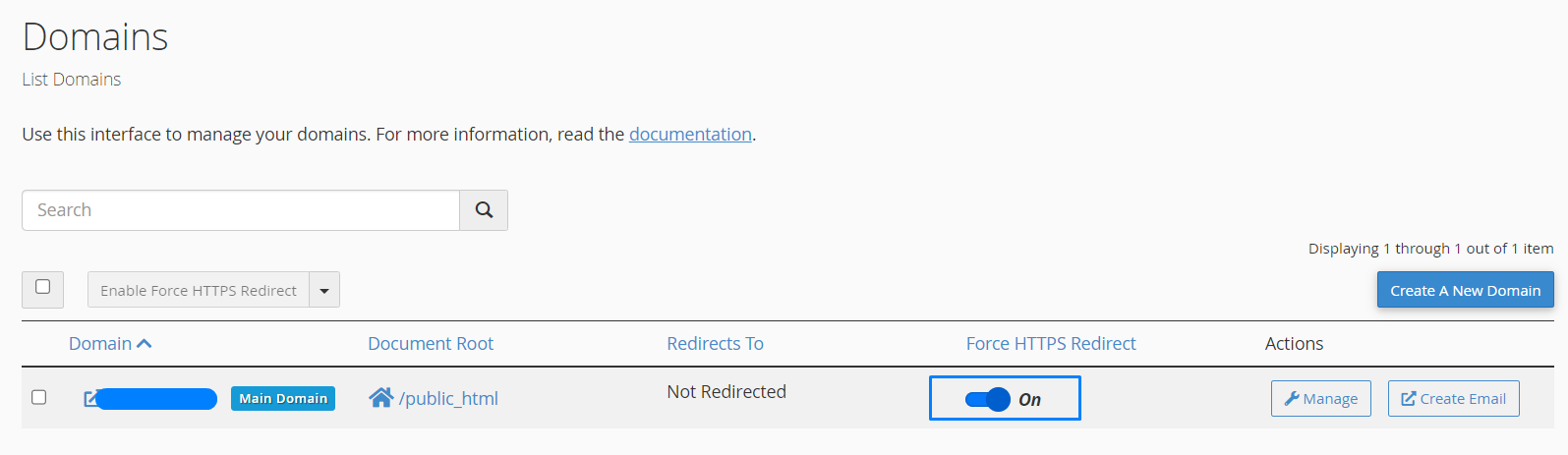
- Enable Force Redirect in the Domains section to automatically redirect HTTP visitors to HTTPS.
- If you want to uninstall the SSL certificate, go to Installation tab

- Now click “Uninstall” option near the installed certification.

Things to Consider for SSL Insecure Error:
1. Wait for DNS Propagation:
- If you recently updated your domain’s A record or nameservers, wait up to 24–48 hours for DNS propagation before installing or reissuing SSL.
- SeekaHost: If your domain uses SeekaHost nameservers, SSL will be installed automatically within 12 hours after the nameserver update.
2. Check Disk Usage:
- If your hosting account has exceeded its disk space limit, free up space by deleting unnecessary files, then try installing SSL again.
3. Check File Usage (Inodes)
- If your inode (file count) limit has been reached, delete unnecessary files to reduce the count, then reinstall SSL.
- If your hosting panel doesn’t show inode usage, contact your hosting provider for assistance.
4. Verify Cloudflare SSL Settings
- If your domain is using Cloudflare and you’re seeing an SSL mismatch or “Not Secure” error, make sure your Cloudflare SSL/TLS settings match your hosting server’s SSL configuration.
- Follow our step-by-step guide on How to Update DNS Records in Cloudflare to configure your SSL/TLS settings properly.
Hope the article guide helps you successfully install SSL for your website.